
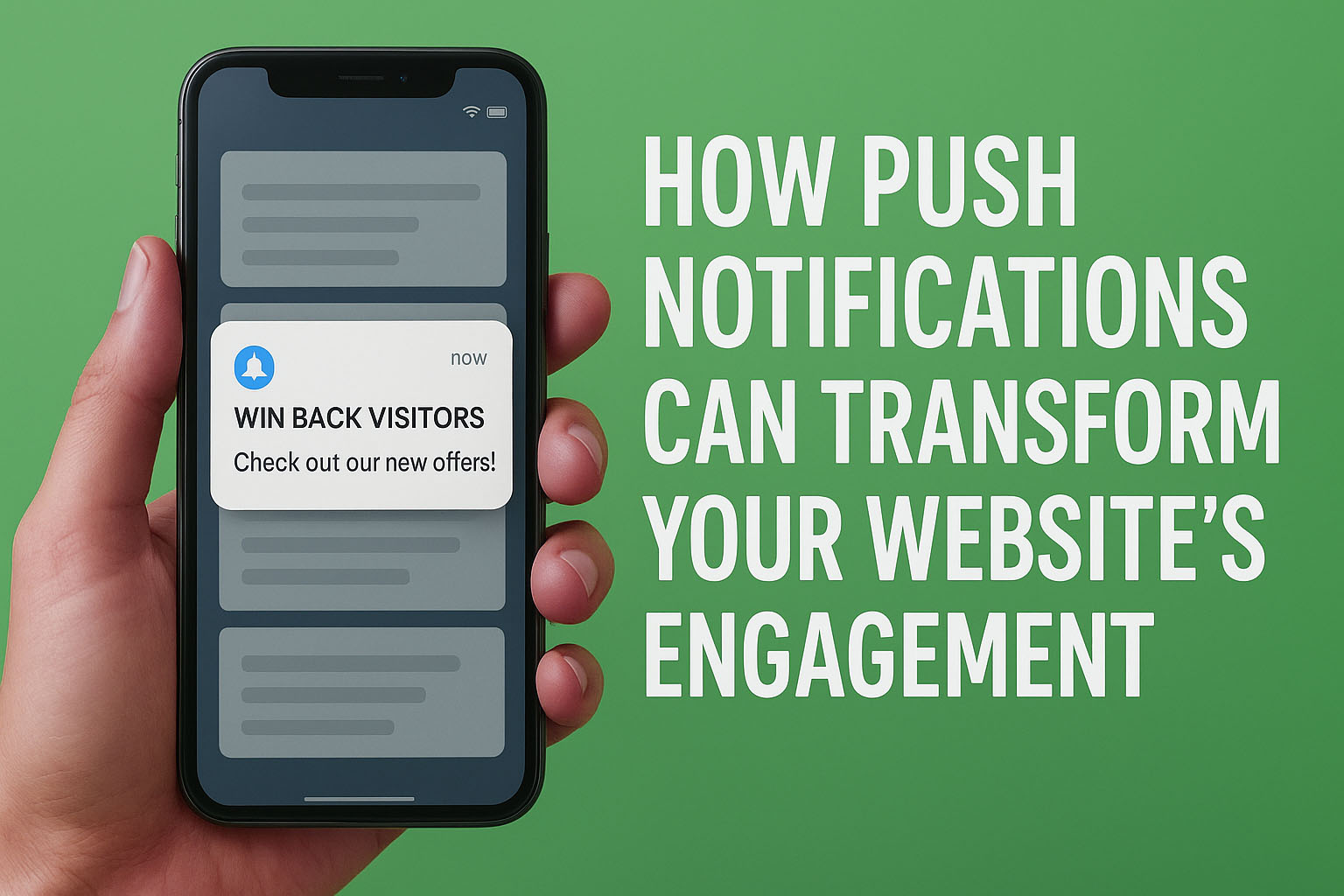
Introduction — a nudge that matters
Imagine a gentle tap on a user’s device that brings them back to your site — not intrusive, but timely, useful, and welcomed. That’s the reality of modern push notifications. For website owners weighing acquisition channels, the importance of push notification for website owners can’t be overstated: it’s a direct, permission-based line to users who’ve already shown interest. When done right, push becomes one of the highest-ROI ways to rekindle visits, recover abandoned sessions, and deepen loyalty. OneSignal
Push vs Email vs SMS — quick comparison
Before we dive deeper, here’s a compact comparison to set the stage.
| Channel | Speed | Reach (opt-in required) | Typical CTR | Best use |
|---|---|---|---|---|
| Push notifications (web/mobile) | Instant | Permission-based (browser/app) | Varies — strong when targeted | Flash sales, price drops, back-in-stock, time-sensitive reminders. OneSignal |
| Minutes–hours | High (if collected) | Lower than push for instant CTAs | Long-form content, receipts, onboarding flows | |
| SMS | Instant | Opt-in required; carrier constraints | High but costly | Urgent alerts, 2FA, transactional updates |
(Stats vary by industry and platform; always run your own A/B tests.)
Why push matters — five concrete reasons
- Permission + prominence = trust & visibility. Push is opt-in; that permission makes recipients more receptive than cold channels. When users allow notifications, you have a persistent way to reach them outside the inbox.
Wisepops - Outstanding short-term lift in retention. Time-sensitive nudges — e.g., a welcome/first-week notification — significantly boost retention metrics. One study shows a single early notification can improve retention dramatically.
MoEngage - High engagement for targeted messages. With segmentation and personalization, click rates can far outpace generic blasts — targeted campaigns have reported CTRs that dwarf baseline figures.
MoEngage+1 - Cost-effective traffic driver. Several publishers report push as a top traffic source, moving thousands of monthly visitors with minimal per-message cost.
WPBeginner - Immediate feedback loop for content & commerce. Push lets you test headlines, CTAs, and timing instantly — a fast path to iterate on what actually converts.
Key insights & research-backed tactics
1) Optimize opt-in UX (the permission moment)
How you ask matters. Use a “push primer” (an on-site modal or banner that explains the value) before the browser permission prompt — this raises opt-in rates and primes expectations. Braze and other engagement platforms emphasize this tactic as a best practice. braze.com
Quick checklist:
- Explain value in one sentence (what they’ll get and how often).
- Offer examples (“price drops, new posts, restock alerts”).
- Delay the browser prompt until the user has demonstrated intent.
2) Segment ruthlessly; personalize surgically
Bundling your audience into “interested in X” buckets and sending tailored CTAs outperforms generic blasts. Leverage behavior (visited pages, cart activity), geography, and time zone to make messages relevant.
Example segments:
- Cart abandoners (30–60 min after exit)
- Recent visitors who viewed a category (48–72 hours)
- VIP repeat buyers (exclusive offers)
3) Timing & frequency — quality beats quantity
Over-notifying is the fastest way to lose permission. Frequency should be driven by user signals and message value. Think: one high-value push a week for casual users, more for active shoppers. Keep messages short and action-focused.
4) Use rich media & deep links
Rich notifications (images, action buttons, and deep links) increase engagement. Direct users to a relevant landing page rather than your home page — reduce friction to convert.
5) Measure the right KPIs
Track:
- Opt-in rate (permission%), by device/OS
- Delivery & open/engagement rate (CTR)
- Conversion per push (revenue, signups)
- Unsubscribe/permission revocation rate
A/B test subject lines, CTAs, time-of-day, and creative. Over time, your dataset becomes your best competitive advantage.
Table: Tactical checklist for the first 30 days
| Day range | Action | Why it matters |
|---|---|---|
| Day 0–3 | Add push primer + permission flow | Improves opt-ins and sets expectations. braze.com |
| Day 4–10 | Segment first-party users (behavior + geography) | Enables relevant targeting. |
| Day 11–20 | Run A/B test on timing & CTA | Find best-performing cadence and copy. |
| Day 21–30 | Launch personalized cart-abandon and re-engagement flows | Immediate conversions and retention lift. MoEngage |
Pitfalls & the modern browser risk
Be mindful: browsers are getting stricter. Google Chrome started experimenting with features that can auto-disable high-volume, low-engagement notifications to reduce user overload. That means websites that spam or send irrelevant notifications risk losing access to this channel entirely. The quality of sends now matters more than volume. The Verge
Takeaway: prioritize relevance, not reach.
Real-world signals (what the industry shows)
- Benchmarks and vendor reports show significant variation by industry and platform — but unanimous guidance: targeted push outperforms untargeted blasts. OneSignal’s reports and industry roundups consistently highlight strong opt-in and engagement when permission flows are optimized.
OneSignal+1 - Publisher case studies show push can be a top traffic source — an example that’s often cited is WPBeginner’s reported monthly visitors via push (tens of thousands), demonstrating economic scalability for sites with repeat content or offers.
WPBeginner
Implementation: tech & tools (practical checklist)
- Choose a provider (OneSignal, Airship, Braze, PushEngage, etc.). Evaluate: pricing, segmentation, API access, analytics.
Airship+1 - Implement a push primer + delayed browser prompt.
braze.com - Instrument analytics to tie pushes to revenue (UTM + tracking).
- Build key flows: welcome, cart recovery, price-drop, content nudge.
- Run weekly A/B tests and prune underperforming segments.
Content ideas that actually convert
- Personalized cart reminders: “Your cart item is low in stock.” (include product image + link)
- Price-drop + back-in-stock: Timely, revenue-driven nudges.
- Content surfacing: “New post: 5 tactics to reduce churn” — for sites with repeat readers.
- Local/event-based: If you run local events or limited windows, use geotargeted pushes.
SEO & on-page integration (internal linking strategy)
- Create a “Resources” page that explains what notifications users will get and link to it from your push primer.
- Internally link push-driven landing pages to related blog posts and product pages to reduce bounce and increase dwell time.
- Tag push campaign landing pages with UTM parameters so analytics can attribute traffic and conversions, then surface top-performing content in related post widgets.
Visual assets & thumbnails
Images and micro-graphics increase CTR for many publishers. Consider:
- A 3:2 hero illustration (isometric, brand-colored) that shows the device + notification preview (your provided thumbnail prompt is solid for this).
- Inline infographics summarizing opt-in best practices or a flowchart of “permission → segment → send → measure.”
Alt text suggestion for featured image: “Isometric illustration of a website push notification appearing above a blue platform with security icons.”
(You provided the thumbnail prompt — use that for the hero image generation.)
References & further reading
- OneSignal — Top push notifications for websites & engagement benchmarks.
OneSignal - MoEngage — Push notification statistics & retention insights.
MoEngage - Braze — Push permission / primer best practices.
braze.com - WPBeginner — How push drives publisher traffic (case example).
WPBeginner - The Verge — Chrome feature to auto-disable ignored website notifications (relevance to send quality).
The Verge